
Biography
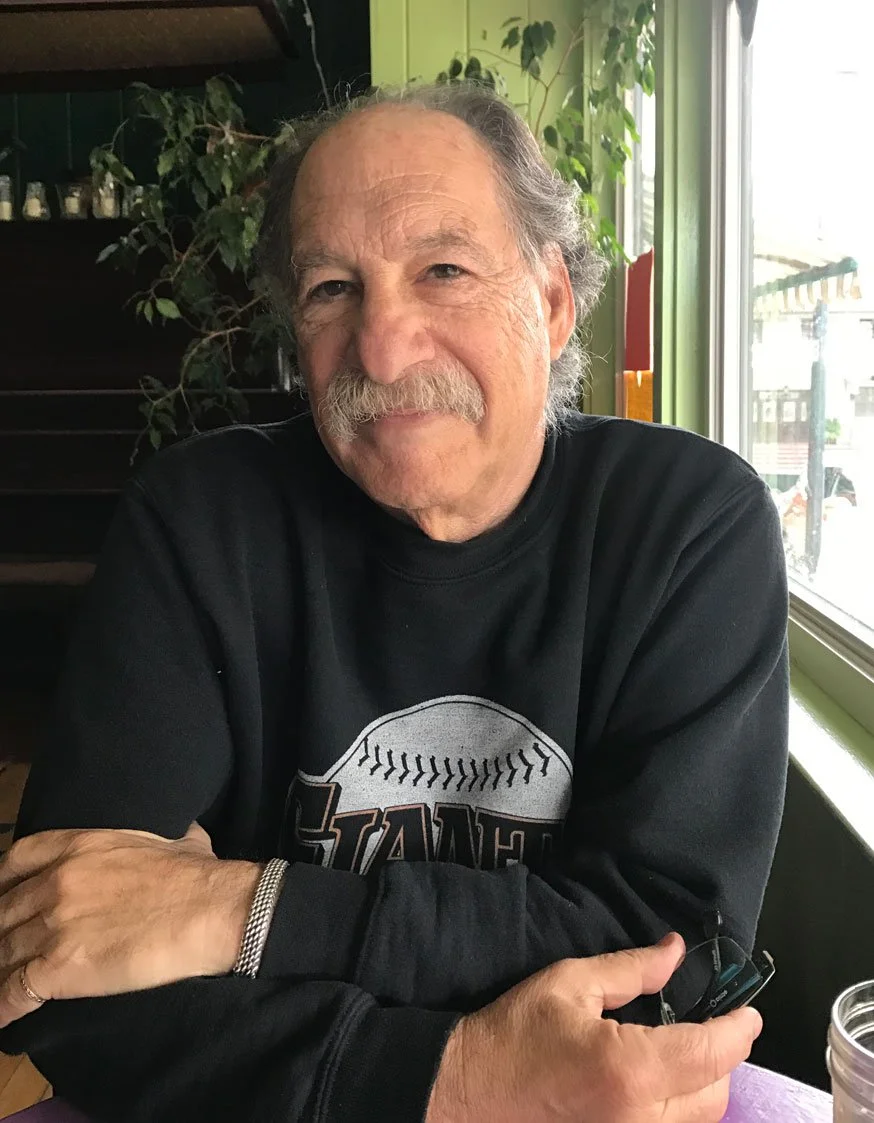
First born Jewish son after the Holocaust, that story.
First generation American, that story, too.
From city to suburbs, Brooklyn to Long Island, near poor to near rich, then rocketing downward mobility. From organized labor (sewing trades on mother's side, restaurant trade on father's), to teacher (mom) and lawyer (dad), to marginalized labor again: part-time teacher until age 40 (no benefits, no retirement, no money), then full-time, tenured teacher, and marginalized writer of fiction.
Union leader, officer, worker, activist in American Federation of Teachers for forty years, until I retired.
Civil Rights: marched, picketed, arrested; present at the 'I Have a Dream' speech, Thanksgiving dinner with John Lewis in Atlanta, and Bo Diddly at the Apollo Theater.
Anti-Vietnam War: marched, picketed, arrested; present at numerous marches on Washington where I once threw a garbage can through a window at the State Department, proving that even then I understood and appreciated the power of imagery and metaphor.
Anti-draft and anti-draft counseling and resistance.
Taught history and political science at A & T, a HBC (Historic Black College) in North Carolina for two years.
Vista Volunteer in Washington, D.C., where I lived in a housing project in Anacostia and was paid by the Office of Economic Opportunity to organize tenants against the Federal Housing Authority, who threatened and tried to have me fired.
Vista Volunteer in Greensboro, North Carolina, where I was paid to teach poor people how to save and spend their money. Instead, organized them in an inter-racial tenant’s union so they could save more money, which they did and used to buy guns to protect themselves from each other and me.
Freedom of Information Act, 25 page largely redacted FBI file in which they spent most of their time trying to figure out if I was married. I was—but they, the FBI, could never seem to verify it. My wife, however, had no trouble verifying it or dissolving it—but she was always better and smarter and more vigilant than they.
Left New York in 1962 to go to school in Madison, Wisconsin. Left Madison in 1968 with two degrees, a teaching credential, a wife, and an unplanned honeymoon detention in Chicago jail during the Democratic National Convention. Spent first night at Lincoln Park with Jerry Rubin, Abby Hoffman, Piglet, and Yippies. Spent the second night in jail. The third night I was in George McGovern's suite in the Conrad Hilton watching the battle on the streets below on TV, all of which helped to contribute to a profound sense of the absurd and dystopian that fifty years later led to my novella, The Night at the End of the Tunnel, or Isaiah Can You See?
Went to Greensboro, North Carolina from 1968-70. I was visited by the FBI. The school was visited by the KKK and the National Guard. One student killed.
Came to Berkeley, California in 1970, one year after People's Park and four months after Kent State. Still married, unemployed, living on welfare and food stamps. Accepted at law school, decided not to go, and began working on a reader of Social Conflict Theory (not published) as well as two political science textbooks with Ken Dolbeare, my major professor/mentor from Wisconsin (both published) and a political science teacher's manual (published). Came face to face with feminism and lost. Happy I could still walk and have kids.
Started teaching history and political science at Merritt College in Oakland—another HBC and the birthplace of the Black Panther Party and Huey Newton and Bobby Seale. Got a National Endowment for the Humanities grant (1977-8) to start an oral history project, à la Studs Terkel, which got me working with older people, which led to my next job, and got me interested in stories and storytelling.
Hired at Vista College (now Berkeley City College) and set up what at the time was one of the largest and most comprehensive older adult education programs in the nation. Had over 150 classes in five towns, over 100 teachers, a budget of half million dollars, and over 5,000 students. Taught well elderly, frail elderly, people who were working with elderly and people who wanted to work with elderly. Program was dismantled thanks to our Republican friends in Sacramento, who later went to Washington and did to the country what they'd already done to the State.
Enrolled at San Francisco State U. and took English and creative writing graduate school courses. What I had finally learned was the line between truth and fiction is porous. I realized that fact and data mean nothing until they are interpreted and once they are interpreted, they are no longer fact and data, but opinion, fiction. So I asked myself, why write (history and political science) stories that sound like the truth when I can write bigger/better truths by making up stories? The answer led me to fiction. That and working with old folks, hearing their stories and learning that all stories are unique and the same. Very humiliating and freeing to realize everything has already happened to someone somewhere and everything is also brand new.
About stories: once when I was very young, my grandfather gave me a dollar and told me to go to the store and buy him a packet of cigarettes. I bought a dollar's worth of candy instead and came back and told him. He spanked me and sent me to my room. Clearly, it would have gone better had I a story to tell.
Years later when I got expelled from high school when a teacher caught me doing something I shouldn't have been doing and heard me say, "You fuck," I knew I'd better come up with a tale. So I told my mother I said, "What luck." She, mother of first-born Jewish son after the holocaust, believed me, defended me, and was shocked when I finally confessed. So I learned another lesson, a lesson repeated again and again after the U-2, Vietnam, Watergate, the Contras, Iran Gate, Monica Lewinsky, Weapons of Mass Destruction, and every utterance out of Trump’s mouth, Sharpie, and keyboard that a story that has real truth in it is better than one that is false.
So I began writing fictions and fabrications to discover my truths and wrote a dozen love and almost love stories that became I Saw a Man Hit His Wife (1997).
In 1991, I went to France, the old world, where everything is new to me, including me. Six years later, Donna and I married—Lucky me!—and I wrote, I'll Never Be French (no matter what I do) (2008), (not quite) Mastering the Art of French Living (2018), and I Am Finally, Finally French, My Accidental Life in Brittany (2025), three memoir travelogues that are so unbelievable they read like fiction even though, I swear, they’re not.